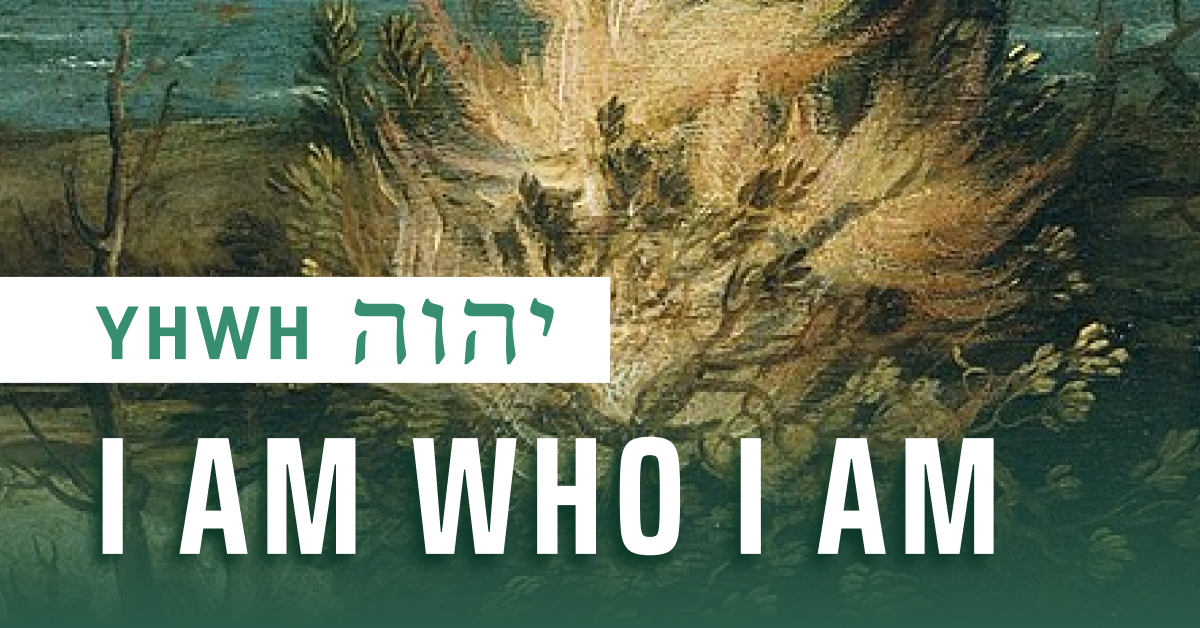
13 Then Moses said to God, “Indeed, when I come to the children of Israel and say to them, ‘The God of your fathers has sent me to you,’ and they say to me, ‘What is His name?’ what shall I say to them?” 14 And God said to Moses, “I AM WHO I AM.” And He said, “Thus you shall say to the children of Israel, ‘I AM has sent me to you.’ ” 15 Moreover God said to Moses, “Thus you shall say to the children of Israel: ‘The LORD God of your fathers, the God of Abraham, the God of Isaac, and the God of Jacob, has sent me to you. This is My name forever, and this is My memorial to all generations.'” (Exodus 3:13-15 NKJV)
God is everlasting; thus, it logically follows that His name would be forever as well. As highlighted in the introduction to our series on the names of God, names have importance. They are not flippant, but have meaning in whatever context they are given in. What I find so fascinating is how the name YHWH has been viewed throughout the millennia. We are going to take some time looking at how this name has been viewed historically, as well as within God’s Word.
What Is His Name?
The given name of God in the original Hebrew consists of four consonants, but is pronounced yeh-ho-VAW. This has led to some people romanizing it as “Jehovah” in recent years, but many people still adhere to the traditional inserting of vowels into the consonants to produce “Yahweh” (pronounced yah-WAY). But what does this word, this name, mean exactly?
If we take a look at the Strong’s Concordance entry for this word, we find that it means “(the) self-Existent or Eternal.” Right away, this name has uniqueness. God’s very name implies His everlasting nature. None other can claim to have existed on their own terms, without the involvement of a Creator, before everything else was (Genesis 1:1; John 1:1; Colossians 1:17). Thus, we can know right from the get-go the following:
- God has always existed; He was not created.
- God will always exist.
- God’s capability of existence rests solely in Himself.
The Brown-Driver-Briggs Lexicon adds another layer to the name of God: “the absolute and unchangeable one.” Not only has God always existed, He has remained the same throughout all time and will continue to do so. This is where we get terms such as “the immutability of God,” denoting His unchanging nature. I have heard God once compared to the Grand Canyon. When we look upon the vastness of this great and awe-inspiring landmark, we wonder at its formation. How could such an imposing monument of sediment be eroded in such a manner? It seems impervious to the elements when one gazes upon its magnificence. But the creation cannot outdo the Creator. God is not weathered; He is not eroded. The God Who breathed existence into being has not changed, adapted, or evolved in any manner (Hebrews 13:8).
That is why we can truly trust in God as our solid Rock. He will never be turned to sand. He will not be smoothed, nor shall He be shaken. It brings to mind the words of that old refrain:
On Christ, the solid Rock, I stand:
all other ground is sinking sand;
all other ground is sinking sand.
Why Is His Name Important?
Our ministry verse at Blue Letter Bible is Psalm 138:2, which says, “I will bow down toward Your holy temple and give thanks to Your name for Your lovingkindness and Your truth; for You have magnified Your word according to all Your name.” (NASB95) As Christians, we know the seriousness of God’s words; they are not to be taken lightly. Here, the Psalmist is worshiping God, giving Him glory for Who He is. But what is interesting here is that he does not say, “give thanks to you, my God.” He specifically is giving thanks to God’s name. That is because, as seen in our previous section, God and His name are inseparable. You cannot have one without the other. There is no God without YHWH.
Let’s look at another verse. In Proverbs 18:10, it says, “The name of Yahweh is a strong tower; the righteous runs into it and is set securely on high.” (LSB) Again, we see a clear equating of Yahweh Himself with His name. Not only that, but we find there is meaning for us here as well. God’s name is not merely an identity or a definition. It is a refuge and a safe haven for His children. Those who believe in His name (cf. John 1:12-13) are secured by their Father’s state of existence.
A couple of years ago, I had the wonderful opportunity to travel with my wife to Europe for a few weeks. It was amazing to see the wonderful architecture and craftsmanship that went into the medieval buildings in England, Scotland, and Ireland. As we were walking up the long, winding staircase of a tower in Blarney Castle, I realized something: “Who would want to try and invade this? It seems so secure.” The steps were twice as high as normal ones, never in a straight line. At one point, I had to almost crawl on my hands and knees to properly climb it. And I was not wearing any armor or carrying any weapons; how did soldiers manage this? If the work of man’s hands can be so intimidating, how much more secure is the name of God?
Thus, we see that we can be secure in Yahweh. His very name, His very identity, denotes safety. As a child, there were people I knew were safe. I had spent time with them and they had gained trust, allowing me to relax around them. The mere thought of my being with me (cf. Deuteronomy 31:6, 8) should cause all of the dread and concern to be replaced with inexplicable relief and joy.
Glorifying YHWH
Growing up as a kid, there were certain people’s names which held weight, right? If you were friends with Zach or knew Pastor Bob, you were a big deal. God is no different; we have merely lost the respect that is due His name. Surrounded by a world who has no problem saying, “Oh my God!” or “Jesus Christ!” as an expletive, we find ourselves desensitized to it. In fact, some of us (myself included) find it coming out of our own mouths in such a way! In the words of Paul the apostle, “May it never be!” (LSB)
Instead, remember this the next time you find “OMG!” on the tip of your tongue. If your father, pastor, or boss were standing right next to you, would you use their name in vain, as a curse or an expletive? Because God is much more than all three of those combined. So treat the name of Yahweh, “I Am Who I Am,” with the utmost deference, respect, and worship.