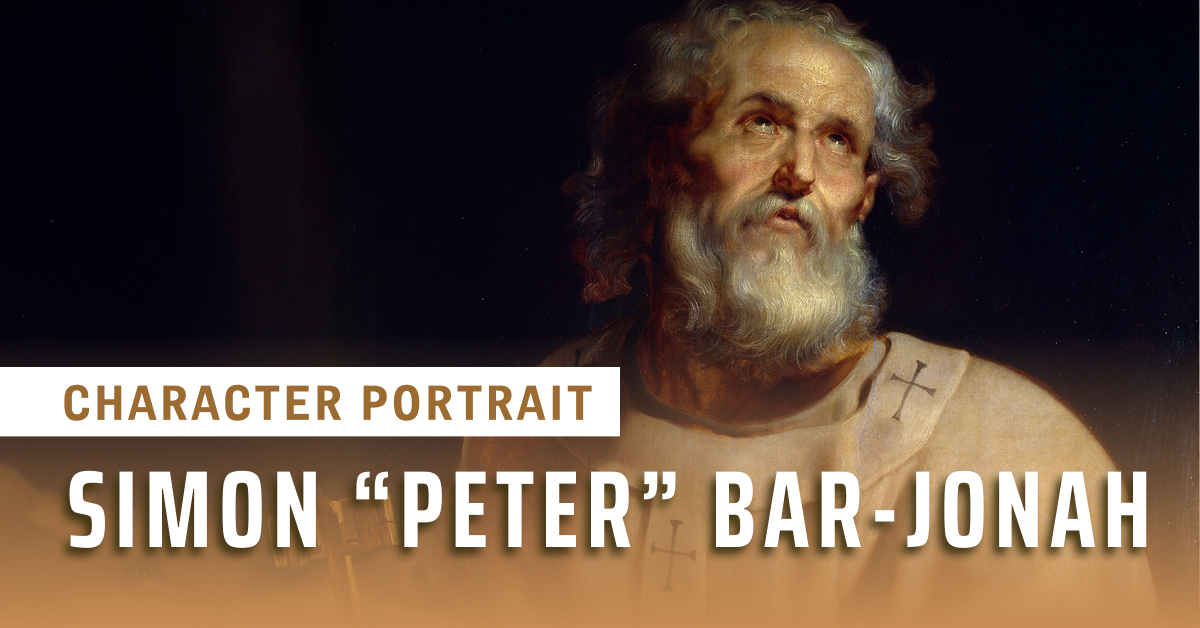
The story of Simon Peter is one of great drama. Viewed by many as the most important of Christ’s disciples, his life was characterized by a series of soaring highs and deep lows. There were times his faith was lauded, but he also experienced significant stumbling. He was called “blessed” and “Satan” by Christ within the same chapter (Matthew 16:13-23).
Many Christians today identify very closely with Peter because of similar peaks and valleys in their own lives—I know I certainly do!
Peter’s life is truly full of irony. When Christ renamed him Cephas (the Aramaic form of Peter; John 1:42), his name came to mean “a rock.” And yet, Peter’s walk was anything but solid. His faith was often small, and his mouth too quick to speak. But Christ still used him mightily for the furtherance of His kingdom and gospel despite these shortcomings. In this miniseries on the Apostle Simon Peter, we are focusing on how he was used by God for the gospel. There is so much to be gleaned from this man’s life, and it is worthwhile to devote the appropriate amount of time to it. As we examine the life of one of the Twelve Apostles, I pray you will be encouraged to consider how God uses you despite your failings and weakness.
A Predictable Beginning
In John 1, we get to see the calling of Simon Bar-Jonah. Andrew, his brother, was a disciple of John the Baptist. John was walking with Andrew and another disciple when he saw Christ, prompting to cry out, “Behold the Lamb of God!” (John 1:36) Andrew and his fellow disciple immediately ran to Christ, and began following Him. Later, Andrew came to Simon and told him he had found the Messiah. In the Jewish culture, this was a massive detail. Oppressed by the dictatorship of the Roman empire, Jews chafed at their subjugation. The promised Messiah of old was believed to be the one who would come and rescue them from Roman rule. Thus, I am sure Peter was most intrigued and even excited to meet this Man who had impressed his brother.
When Andrew presented Simon to Jesus, He bestowed Simon with a new name: Peter. We do not know exactly what Peter was thinking, but I am sure he was amazed at Christ. Who was this carpenter Who wielded His words with such authority? After this initial meeting, Jesus and His disciples were invited to a wedding in Cana. At this wedding, Peter saw the impossible: this Man turned water into wine (2:1-11). It begins to settle in: maybe this really is the Messiah they have all been waiting for. While they remain Christ’s disciples, Peter and Andrew return to fishing on the Sea of Galilee.
One day, Peter and Andrew were packing up from a fruitless night of fishing without a catch (Luke 5:1-11). Jesus came to them, and told them to cast out once more. Here, we see the burgeoning disbelief Peter would unfortunately come to characterize during the earthly ministry of Christ. He immediately questions, wondering what the point is when they have been working tirelessly through the night for a catch to no avail. However, he still relents and does as he is asked. Lo and behold, his nets are overwhelmed by the sheer number of fish, requiring two boats to even pull in the catch. Immediately, we see Peter’s response to Christ; he falls on his face, crying, “Depart from me, for I am a sinful man, O Lord!” (v. 8) Jesus here encourages Peter to not be afraid (not for the last time), commissioning him, Andrew, James, and John to now be fishers of men. And so, they leave behind everything and follow Him.
Much like Peter, many of us have rough beginnings to our faith journeys. We question the will of God, wondering what the point is. Why must we repeat the same things that we already tried and failed in? We diminish the impact of having God in our lives, ignoring His unlimited power and knowledge. Even Abraham was guilty of wondering at the power and ability of God (Genesis 17:17). But our God is so faithful, isn’t He? Even when His children wonder at what He puts before them, He remains patient and works all in their lives to their benefit (Romans 8:28).
The Ups and Downs of Ministry
Now commissioned as a disciple (and later as one of the Twelve [Matthew 10:1-2; Mark 3:13-16; Luke 6:12-14]), Peter began to accompany Christ as He went about His earthly ministry. He watched his Master perform numerous signs and wonders for the populace, including the miraculous healing of his own mother-in-law (Matthew 8:14-17; Mark 1:29-34; Luke 4:38-41). He heard numerous teachings and parables, many of which left Peter and his fellow apostles confused (Matthew 13:10). Peter was also sent out, along with the rest of the Twelve, giving them “power and authority over all demons, and to cure diseases” (Luke 9:1). We could dive into many of the accounts featured from the ministry of Christ, but there are three I want to focus on for Peter. While all of these events are recorded in the three Gospels, I will be focusing on Matthew’s rendering of them.
The first is Peter’s walking on the water, which can be found in Matthew 14. After Christ feeds the five thousand, He sends the disciples away in a boat to the other shore. Christ then sends the people away so He can retire to the mountain and pray. As Peter and his fellow disciples load up, I am sure confusion was rampant. Why were they leaving their Master behind? Should they stay with Him to make sure He was protected and looked after? Whatever their musings amongst themselves, they depart into the sea once more. Unfortunately, they are unable to make it to their intended destination. Instead, they are beset by a violent storm and caught up by tossing waves. While inclement weather was a common hazard for many of these men (especially the fishermen such as Peter, Andrew, James, and John), there was a certainly an aspect of discomfort and fear present among them.
Suddenly, in the early hours of the morning, they spot something moving across the water towards them. A human figure was walking across the turbulent waves towards them! Panic set in, many thinking it was a ghost or some other spirit. However, the specter calls out to them; it is Christ! I can only imagine how awe-inspiring it was to see this firsthand. You are sitting in a boat that has been tossed about for hours on end, and you see the Man who just turned five loaves of bread and two fishes into enough food to feed thousands of people walking across the water towards you. Personally, I would be speechless. But not Peter.
Peter answers Christ, asking if he can join his Master. Here, we see the faith of Peter. He does not question how Christ is doing this miracle. In fact, he automatically assumes Christ has the power and authority to permit him to do the same. And so, he says, “Command me to come to You on the water.” (v. 28) Christ tells him simply to come; and so, Peter gets out of the boat. Soon, he is walking towards Christ. The shock of the other disciples must have been palpable. Of course, Jesus could walk on water; they had seen His power. But now Peter also was walking! He continues out towards Christ, his focus and gaze fixed squarely on his Master. But the moment he notices the turbulent wind and waves, doubt comes crashing down, pulling him below the water. He cries out in fear for the salvation of Christ, which is quickly rendered to him. And Jesus simply says, “O you of little faith, why did you doubt?” (v. 31)
Are we not just like Peter here? We can have all the assurances in the world. We can be walking forward steadily, unhindered as we focus on God and His power. But the moment our attention slips away from Him, we notice he turbulence of the world. Anxiety and fear overtakes us as we drown in the problems of this carnal life. We cry out for salvation from our current situation. And yes, praise God for His deliverance in those times! But why did we falter? Had we merely continued to keep our gaze heavenwards on the destination instead of on the path we were on, we would not have stumbled. This is the lesson from Peter here: keep your gaze heavenward (Colossians 3:1-2).
Secondly, we have Peter’s confession of Christ as the Messiah, which is found in Matthew 16. Jesus asks the disciples who the people say He is (16:13-14) before following up by asking them their own thoughts. This is when we see Peter blessed with knowledge not his own: “You are the Christ [Messiah], the Son of the living God.” (v. 16) Jesus praises Peter for this revelation that has been given him. I’m sure Peter was feeling pretty proud of himself after this. Throughout the Gospels, there is a consistent power struggle amongst the apostles of who is the greatest among them. And here, Jesus is telling them all that Peter was given some special knowledge. Wouldn’t we also feel pretty important in the same situation?
Unfortunately, Peter’s triumph is short-lived. A few verses later, Peter is taking aside Jesus and rebuking Him. Rebuking Him! The reason for the rebuke was Christ’s discussion of His coming suffering, death, and resurrection. I have no idea what was going through the minds of the rest of the disciples, but Peter obviously focused only on the negative portion. I imagine He, feeling very self-important and protective of Christ, saw it as his duty to dissuade Christ of such “foolish” notions. Christ’s response is cutting: “Get behind Me, Satan!” (v. 23) The devastating effect that must have had on Peter is difficult to think about. How would we feel if our Savior called us by the name of our greatest enemy, Lucifer himself? But we are the same as Peter, thinking we know what is best for God. Let us learn from this example and submit what we believe is best to God’s perfect will.
The third and final instance is the transfiguration of Christ (17:1-13). We have a definite time frame of when this occurs, a mere six days after Peter’s quick rise and catastrophic fall. Sadly, he is not done sticking his foot in his mouth yet. Christ takes Peter, James, and John to a high mountain where they see something amazing. Christ began shining, His robes turning stark white, and he was joined by Moses and Elijah as they conversed before the three disciples. We then have Peter do something incredibly foolish, possible spurred by a desire to redeem himself after his early failure. He offers to build three tabernacles for Christ, Elijah, and Moses.
In the other two accounts found in Mark and Luke, it is made clear this was a wrong move. Peter had just equated the Man he himself had said to be the Son of God with Moses and Elijah, two lowly mortal men. Immediately, the voice of the Father thundered from heaven, commanding the three to hear the words of Christ. In fact, God interrupts Peter, giving him no time to wonder whether he had made an error. Terrified, the three disciples collapsed to the ground. When they dared look up, Elijah and Moses had disappeared, leaving Christ alone standing before them. Again, we see Peter’s desire to do something for God. He is missing the point, just as you and I do every day. We can do nothing for God, for any work we can conjure up is meaningless before His glory (Isaiah 64:6).
Our God Is Patient
As we complete our examination of this first part of Peter’s journey, I find myself amazed at how both Peter and I never learn our lessons. Oftentimes, I find I create my own problems. The Lord gives me a task to do, but I am not satisfied with being diligent to what He has given me. Instead, I must over-analyze, seeking a better path if there is one. There is only one path you will find yourself going down when you second-guess the perfect plan of God; it is one of misery, failure, and defeat. And yet, I never learn. Just like Peter, the next day comes and the cycle continues to repeat. I know that many, if not all, reading this relate closely to these accounts as well.
What is the purpose then? What theological significance can we glean from Peter’s actions in these accounts? It is simply this: God is patient. In spite of his many failings, Christ never once turned His back on Peter. Peter lost faith in Him, rebuked Him, and demeaned Him before His Father. But Christ remains faithful to the faithless. Just as God promised the Israelites (Deuteronomy 31:6), Jesus is never gone from our side. He stands before the throne of the Father, interceding for us. He stands beside us, empowering us to weather the storms of life. All you and I must do is keep your eyes focused on Him. He has given us the gift of eternal salvation; now, we must depend on Him for daily salvation as well. Seek Him at all hours of the day and in all things, whether they be blessings or trials.